Stop Re-Reading Your Notes. It’s Not Working.
Here’s the brutal truth: re-reading your notes won’t get you through SQE1. It feels productive, sure. But it’s passive learning, and passive learning doesn’t stick. The SQE1 isn’t a memory test — it’s about applying legal principles under pressure. If you’re not practicing that skill, you’re setting yourself up to fail.
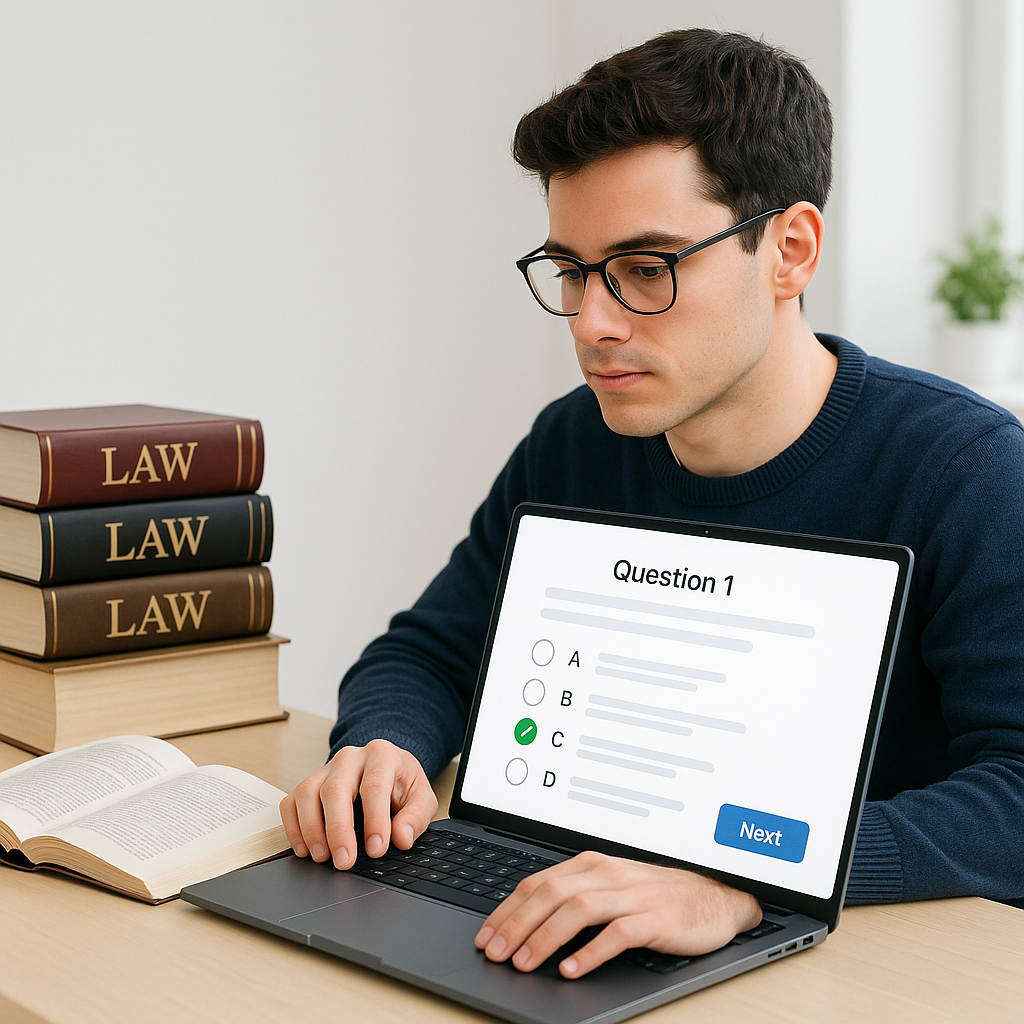
So, what should you do instead? Active recall. It’s scientifically proven to be the most effective way to learn. You force your brain to retrieve information, strengthening your memory and understanding. And guess what? Answering MCQs is active recall in action.
Why MCQ Drills Work (And Why Most People Don’t Do Enough)
Let’s break it down. SQE1 has 360 multiple-choice questions split across two papers. That’s a lot of questions. But here’s the kicker — most candidates don’t practice nearly enough MCQs before exam day. Why? Because they either don’t have access to a quality question bank or they think reading about the law is enough. It’s not.
Focused drills, like the ones we built into SQE1 Drills, are designed to mimic exam conditions. You can configure sessions by subject (e.g., Business Law or Criminal Law), choose the number of questions (10, 30, 60), and even simulate timed conditions. Practicing this way doesn’t just test your knowledge — it builds your stamina. Imagine sitting through 180 questions in one go without training for it. Miserable, right?
The Analytics You Need (Not the Fluff You Don’t)
Practice is great, but it’s useless if you’re not tracking your weak spots. Here’s a common scenario: you keep drilling questions, but you’re scoring 40% on Land Law every time. Do you know you’re weak there? If you’re not analyzing your results, probably not. And that’s where people go wrong.
We’ve embedded real-time analytics into SQE1 Drills for this exact reason. After every session, you’ll see a breakdown of your accuracy, time per question, and — most importantly — which topics are dragging you down. If your score in Solicitors’ Accounts is under 60%, the platform flags it as a weak area. No guesswork. Just actionable insights.
What About Fresh Material? Running Out of Questions Is a Real Problem
Here’s something frustrating: traditional question banks run dry fast. You tear through them, only to find you’re repeating the same questions. That’s bad for two reasons. First, you end up memorizing answers rather than learning the material. Second, you lose the challenge of seeing new scenarios.
That’s why SQE1 Drills uses AI to generate ~100 new questions every night, grounded in the SRA’s assessment specifications. Realistic scenarios. Single-best answers. Zero fluff. And because the AI validates everything, you’re not wasting time on poorly written questions. It’s like having an infinite question bank that just works.
You’ve Got to Commit to Consistency
Here’s the thing about SQE1 prep: cramming doesn’t work. You need a daily habit. Think about it — building confidence with the format and content takes time. That’s why we added a streak system to SQE1 Drills. Answer questions every day, even if it’s just 10. Keep the streak alive. It’s a small psychological trick, but it works.
Bottom Line: Active Recall Isn’t Optional
If you’re serious about passing SQE1, stop wasting time on passive study methods. Get into the habit of drilling MCQs daily, tracking your weak spots, and simulating exam conditions. The SQE1 pass rate hovers around 53-56% (Law Gazette), so you need every advantage you can get.
Tools like SQE1 Drills make active recall accessible, affordable, and — dare I say — even a bit motivating. At £5/month, it’s probably the cheapest investment you’ll make in your legal career. But even if you don’t use it, commit to active recall. It’s the only way to win this game.
Ready to see SQE1Prep in action?
AI-powered SQE1 exam preparation platform with focused MCQ drills, real-time analytics, weak-topic detection, and an AI tutor — from just £5/month.
Get Started Free →