BigLaw's AI Spending Spree: Flashy, But What About You?
BigLaw firms are throwing money at AI like it's confetti. A&O's legal tech spend? Estimated at £40 million last year alone. Latham's AI-driven due diligence tools? They’re already cutting review times by 30% [(Source: Legal Tech News)]. All this investment is reshaping how firms work, but let’s not kid ourselves: it isn’t solving the challenges faced by aspiring solicitors.
You might be thinking, “Doesn’t AI make it easier to qualify as a solicitor?” Nope. If anything, it raises the bar. Firms now expect candidates to understand not just the law but how these tools work. And that starts with passing SQE1. No AI can drill “Consideration in contract law” into your brain. That’s still on you.
Why AI Isn't Your Shortcut to SQE1 Success
Here’s the hard truth: AI tools in BigLaw are designed to increase efficiency for firms, not for candidates trying to pass SQE1. GPT-4 might draft a contract in seconds, but it won’t help you choose between four nearly-identical MCQ options on FLK1. Why? Because the SQE1 exam tests you, not your tools.
Let’s consider an example. Imagine you’re tackling a question on Solicitors’ Accounts, and you’re stuck. AI won’t swoop in to explain why Option C is wrong. But a focused platform like SQE1 Drills will, with its AI tutor breaking down the concept in plain English. That’s the kind of AI you need—an exam-specific assistant, not a generic chatbot.
Actionable Steps:
- Know the Limits of AI Tools: While tools like GPT-4 can assist with legal research or drafting, they aren’t going to master SQE1’s multiple-choice questions for you.
- Use AI for Targeted Learning: Opt for platforms like SQE1 Drills that align with your study goals, providing topic-specific feedback.
- Focus on Active Learning: Instead of relying on passive AI-generated summaries, invest time in solving practice questions and reviewing detailed answer explanations.
The Catch With AI-Powered Question Banks
BigLaw’s AI is impressive, but it’s not building question banks for SQE1. That’s your problem to solve. And it’s a big one: failing SQE1 often boils down to running out of fresh practice questions. Retakers know this pain all too well.
Case Study: The Repeater’s Dilemma
Take Sarah, an aspiring solicitor who failed her first attempt at SQE1. “I ran out of practice questions that felt relevant,” she admitted. “I kept cycling through past papers, but by the end I was just memorizing answers—not learning.”
This is where SQE1 Drills comes in. By adding 100 new MCQs daily, grounded in the SRA’s specifications, the platform ensures you’ll always have fresh material to work with. Weak-topic detection means you’re not wasting time on concepts you’ve already mastered, but instead drilling into areas like Wills or Tort where you need the most help.
Why This Matters:
- Traditional Question Banks: Limited in scope and often outdated.
- AI-Generated Questions: Adapt to your learning needs, offering dynamic, up-to-date practice aligned with exam standards.
Actionable Steps:
- Track Your Weak Areas: Use platforms with built-in analytics to identify where you’re struggling.
- Prioritize Fresh Content: Avoid question banks that recycle old material or don’t update regularly.
- Simulate Exam Conditions: Practice under timed conditions to prepare for the real thing.
How BigLaw's AI Sets New Expectations
Here’s the kicker: BigLaw’s obsession with AI means they’re hiring for a new skillset. Tomorrow’s solicitors won’t just know the law; they’ll need to know how to apply it using AI tools. That means understanding the legal principles behind automated document review or risk analysis.
Real-World Impact
Consider the rise of AI-powered tools like Kira Systems, which automates contract analysis. Junior associates who traditionally spent hours reviewing NDAs are now expected to interpret the AI’s output instead. This requires a deep understanding of both the legal issues at hand and the technology’s limitations.
But guess what? That starts with mastering the fundamentals. You can’t critique an AI’s decision-making process on “exclusion clauses in contract law” if you don’t understand the basics yourself. SQE1 is where you build that foundation, and tools like SQE1 Drills ensure you’re doing it efficiently.
Actionable Steps:
- Learn the Basics First: Build a strong foundation in core legal principles before diving into AI tools.
- Stay Curious About Legal Tech: Read up on tools like Kira Systems, ROSS Intelligence, or Luminance to understand what’s shaping the industry.
- Focus on Transferable Skills: Analytical reasoning, problem-solving, and attention to detail remain critical regardless of AI advancements.
Staying Ahead in the AI Arms Race
You don’t need to outspend BigLaw to stay competitive. What you need is consistency and focus. Build a daily study streak. Drill weak topics relentlessly. And use tools that are designed for your needs, not corporate efficiency.
Comparison Table: AI for BigLaw vs. AI for SQE1 Candidates
| Feature | BigLaw AI Tools | AI for SQE1 Candidates |
|---|---|---|
| Primary Goal | Increase efficiency in legal processes | Improve exam readiness |
| Examples | Kira, Luminance, ROSS Intelligence | SQE1 Drills, topic-specific AI tutors |
| Focus | Automating document review, risk analysis | Targeted practice, weak-topic detection |
| User Base | Associates, partners | Aspiring solicitors |
| Cost | Millions annually | Affordable subscriptions |
Actionable Steps:
- Leverage Affordable Tools: Don’t get distracted by flashy BigLaw tech. Use exam-specific platforms.
- Create a Routine: Build habits like daily question practice to stay consistent.
- Turn Weaknesses into Strengths: Focus on areas where you score poorly to see the biggest improvements.
FAQ
1. Can’t I just use GPT-4 to study for SQE1?
GPT-4 and similar AI tools can assist with research or drafting, but they’re not built for SQE1’s multiple-choice question format. You need a platform that aligns specifically with the SRA’s syllabus and exam requirements.
2. How do I know if I’m improving?
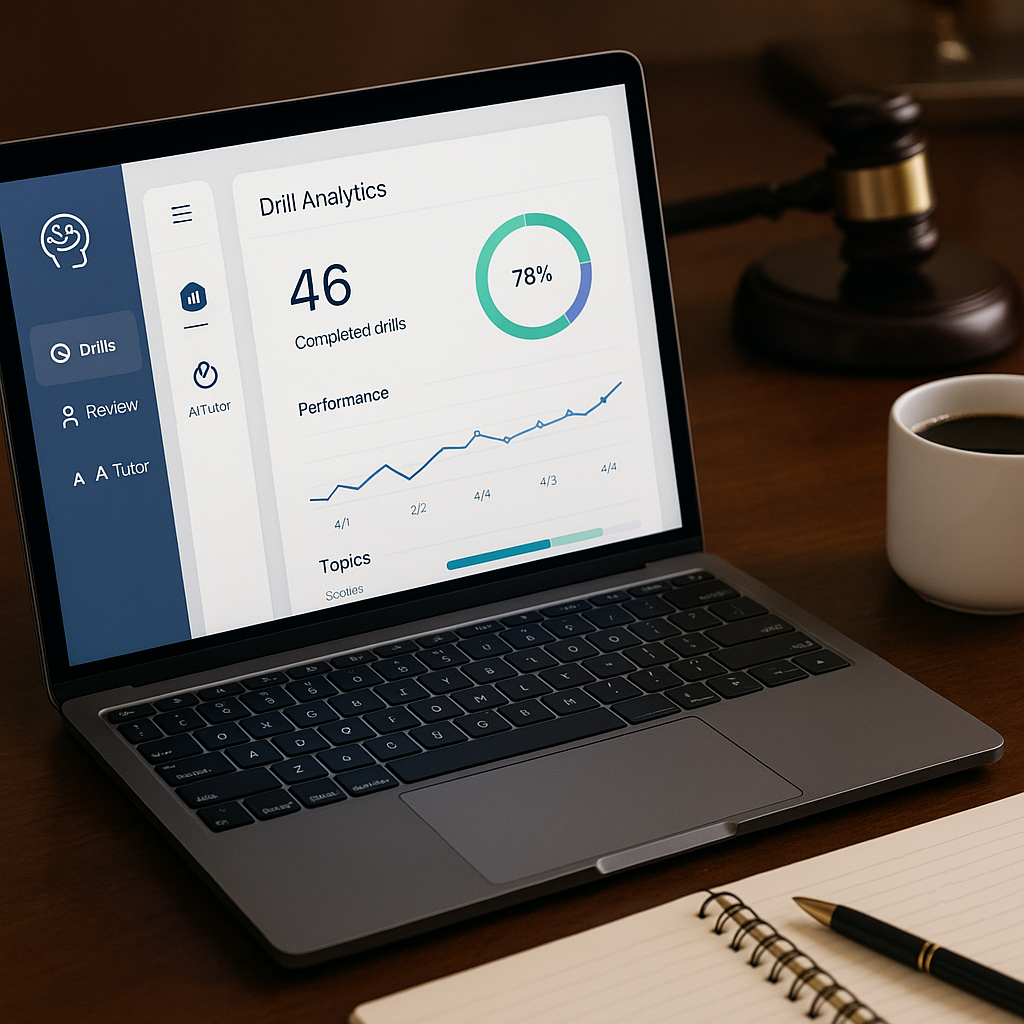
Use platforms with built-in analytics. For example, SQE1 Drills tracks your performance over time, highlighting weak topics and showing progress.
3. Are all AI-powered question banks the same?
No. Many generic question banks lack depth or relevance to SQE1. Look for platforms that generate fresh, exam-specific questions and offer detailed explanations.
4. How much time should I dedicate to studying each day?
Consistency matters more than hours. Aim for 1–2 focused hours daily, prioritizing weak areas and reviewing mistakes.
5. Will BigLaw’s AI replace junior solicitors?
Not anytime soon. AI tools automate repetitive tasks, but they still require human oversight and legal understanding. Your job is to stay relevant by mastering both the law and how AI tools function.
Ready to Tackle SQE1?
If you’re serious about passing SQE1, we’ve got you covered. Start your 30-day free trial on SQE1 Drills →