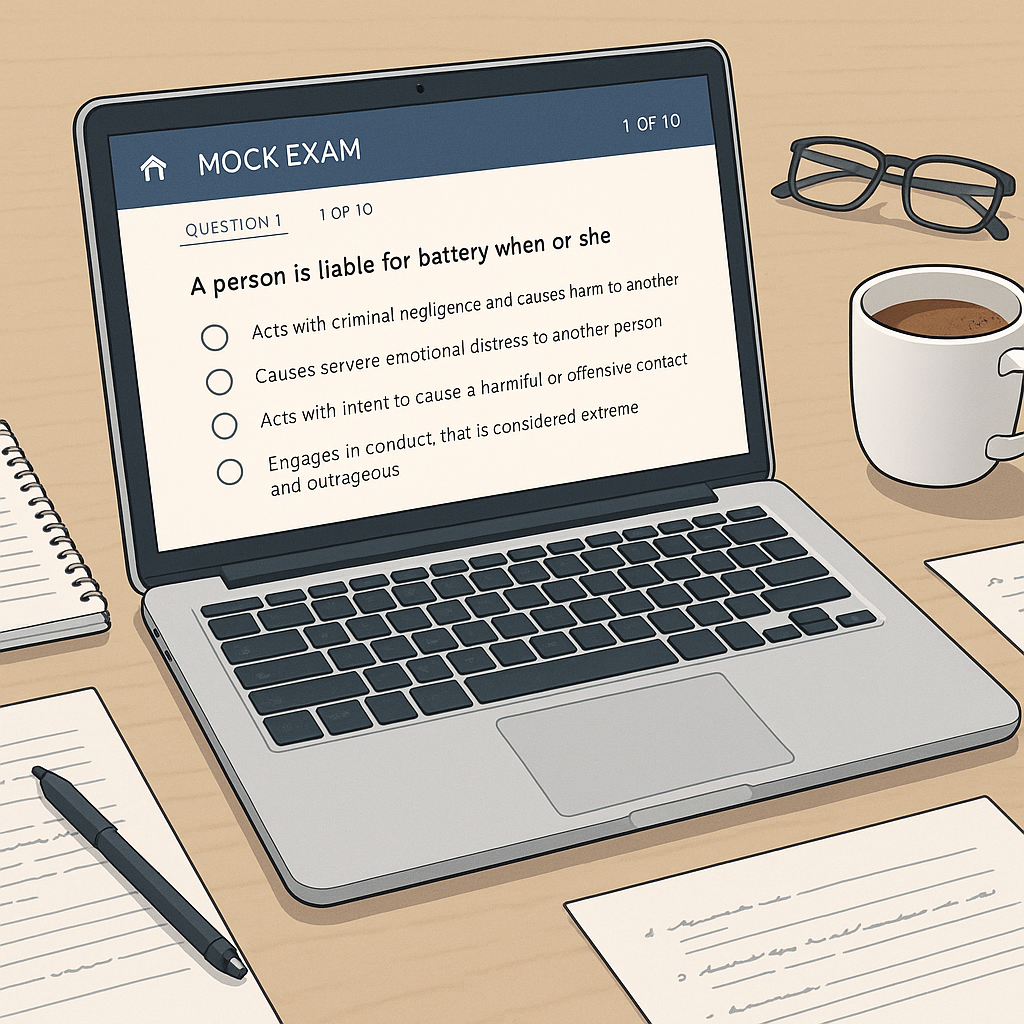
How to Pass SQE1 Multiple Choice Questions (Even When You're Stuck)
Let’s face it: multiple-choice questions (MCQs) can be brutal. They’re designed to trip you up, confuse you, and make you second-guess yourself. And on the SQE1 exam, where you’re up against 360 of them across two papers, the pressure is relentless.
The worst part? Even when you’ve studied hard, you’ll hit questions where you just don’t know the answer. What do you do then? Guess randomly and hope for the best? Skip it? Panic and spiral?
Stop. You don’t have to know everything to pass SQE1. In fact, with the right approach, you can tackle even those “I have no idea” moments strategically. Here’s how.
Start With Elimination
Here’s the golden rule of multiple-choice tests: you don’t need to know the right answer; you just need to eliminate the wrong ones. Each incorrect option you cross off increases your odds of guessing correctly.
Let’s say you’re staring at a question about easements in Land Law. You don’t remember the exact rules for easements, but you spot an answer that mentions the word “license.” If you know that licenses and easements are different legal concepts, you can confidently cross that one out.
The trick is to rely on partial knowledge. You might not know the full answer, but even spotting a few red flags or patterns can help you narrow things down. And narrowing is enough.
Actionable Steps for Elimination:
- Spot keywords: Look for specific terminology that makes an answer unlikely. For example, if a criminal law question mentions “strict liability” in an area where intent is required, that’s probably wrong.
- Cut extreme answers: Words like “always,” “only,” or “must” are often signals of incorrect options. Legal principles rarely work in absolutes.
- Check for logical inconsistencies: Sometimes, an answer may contradict basic legal concepts you know, even if you don’t recall the full details.
Look for Distractors (They’re Designed to Mislead You)
Exam writers love distractors. These are the options that look plausible but are subtly wrong. For example, they might throw in answers that are too extreme, overly broad, or just slightly off.
Here’s a classic example:
Which of the following is a valid form of consideration in contract law?
- A. A past act that benefited the promisor
- B. A promise to perform an existing contractual duty
- C. A forbearance from suing on a valid claim
- D. A moral obligation
If you’ve done enough practice questions, you’ll recognize that A and D are obvious distractors. Why? Because past acts and moral obligations aren’t valid consideration—basic contract law. Even if you’re unsure about B or C, eliminating the two wrong answers gives you a 50/50 shot. That’s a huge improvement over random guessing.
How to Get Better at Spotting Distractors:
- Learn common traps: For example, “past consideration” is almost always a distractor in contract law questions.
- Identify overly broad or extreme answers: Answers that make sweeping claims (e.g., "all contracts must be in writing") are often wrong.
- Practice pattern recognition: The more MCQs you attempt, the more familiar you’ll become with common tricks examiners use.
Drill Your Weak Spots, Not Your Comfort Zones
Here’s a mistake I see all the time: candidates practice what they’re already good at. Why? It’s comfortable. It feels good to ace a drill on a topic you already know well. But that’s not how you pass SQE1.
The exam covers an overwhelming range of topics—everything from EU Law to Solicitors’ Accounts. You can’t afford to leave gaps in your knowledge. If you’re consistently scoring 40% in Tort Law but ignoring it because you hate it, you’re setting yourself up for failure. The SQE1 pass mark isn’t forgiving.
Methods for Effective Weak-Spot Drills:
- Use analytics tools: Platforms like SQE1 Drills analyze your performance by topic. Focus on areas where your accuracy is below 60%.
- Create micro-topics: Break down broad subjects into smaller components. If you’re struggling with Criminal Law, focus on subtopics like defenses, homicide, or theft.
- Repeat until mastery: Don’t move on until you consistently perform well in weak areas. Progress in weaker subjects will boost your confidence.
Time Management is Key
Imagine this: you’re halfway through Paper 1, and suddenly you realize you’ve spent 20 minutes stuck on a cluster of tricky questions. Now you’re rushing through the rest, making careless mistakes, and feeling your confidence evaporate. Sound familiar?
SQE1 gives you 5 hours to answer 180 questions per paper. That’s 100 seconds per question. If you’re spending 3 minutes on a single question during practice, you’re setting yourself up for trouble.
How to Manage Your Time Effectively:
- Set a time limit per question: When practicing, aim for 90–100 seconds per question. Use a timer to stay disciplined.
- Flag tricky questions: Don’t waste time agonizing over one question. Guess, flag it, and return later if time allows.
- Simulate real conditions: Tools like Exam Mode on SQE1 Drills replicate actual exam scenarios, helping you adjust your pace.
Guess Smarter (Yes, There’s a Strategy)
Sometimes, you really do have no idea. That’s okay. Guessing doesn’t mean closing your eyes and picking randomly. There’s a better way.
Guessing Strategies:
- Look for patterns: If you’ve answered “C” for the last five questions, it’s unlikely to be “C” again. Most exams randomize correct answers.
- Avoid extreme language: Answers with words like “always,” “never,” or “must” are often incorrect because legal scenarios are nuanced.
- Stick to one letter for guesses: If completely unsure, pick a single letter (e.g., “B”) and use it consistently across guesses. It increases your odds statistically.
Common Mistakes to Avoid
- Skipping questions without flagging them: Always mark unsure answers so you can revisit them if you have time.
- Wasting time on one question: If you’re stuck, guess and move on. You can’t afford to fall behind.
- Ignoring weak topics: It’s tempting to focus on your strengths, but SQE1 tests breadth. Weak-topic drills are your best friend here.
- Not practicing under timed conditions: Don’t let the clock become your enemy on exam day.
FAQ
1. What’s the best way to practice multiple-choice questions?
Active recall is key. Answer as many questions as you can, and review what you got wrong. Use targeted drills to focus on weak areas.
2. How do I improve my accuracy with MCQs?
Look for patterns in your mistakes. Are you rushing? Misreading questions? Falling for distractors? Tools like SQE1 Drills can help pinpoint these issues.
3. Should I guess if I don’t know the answer?
Yes. Always guess. Eliminate as many wrong answers as you can, then make an educated guess. Never leave a question blank.
4. How can I manage my time better during the exam?
Practice with a timer. Use tools that simulate real exam conditions, like SQE1 Drills’ Exam Mode. This helps you get used to the pacing.
5. What should I do if I consistently score low in a subject?
Focus on weak-topic drills. Break the subject into micro-topics and practice repeatedly until your performance improves. Avoid ignoring the subject entirely.
Comparison Table: Key Strategies for SQE1 MCQs
| Strategy | Benefits | How to Apply |
|---|---|---|
| Elimination | Increases odds of guessing correctly | Cross off wrong answers using partial knowledge |
| Spotting Distractors | Avoids falling for traps | Practice identifying extreme/broad answers |
| Weak-Spot Drills | Strengthens weaker subjects | Use analytics tools to pinpoint weak areas |
| Timed Practice | Prevents time running out | Practice under timed conditions regularly |
| Smart Guessing | Improves random guesses | Stick to one letter or identify patterns |
If you’re struggling with MCQs, you don’t need to go it alone. SQE1 Drills offers affordable, AI-powered tools to help you target your weak spots, practice under exam conditions, and boost your confidence. Start your free trial today and see the difference.