Why Most SQE1 Prep Fails
SQE1 isn’t easy. With 360 questions split across two papers, it’s a marathon of legal knowledge. But here’s the kicker: most candidates spend hours reading textbooks and watching lectures, thinking they’re ‘studying’. Spoiler alert—it’s not enough. Passive learning doesn’t work. Research shows that active recall, like answering questions from memory, is far more effective for retaining information (Scientific American).
So why don’t more candidates use it? It’s time-consuming. You need a lot of questions, and you need immediate feedback to learn from mistakes. That’s where tools like SQE1 Drills come in.
The Power of Question-Based Learning
Active recall forces you to retrieve information, strengthening neural pathways. When you answer a question, you’re testing if you really know the material—not just vaguely remember it from last week’s lecture. And unlike passive methods, it shows you where your gaps are.
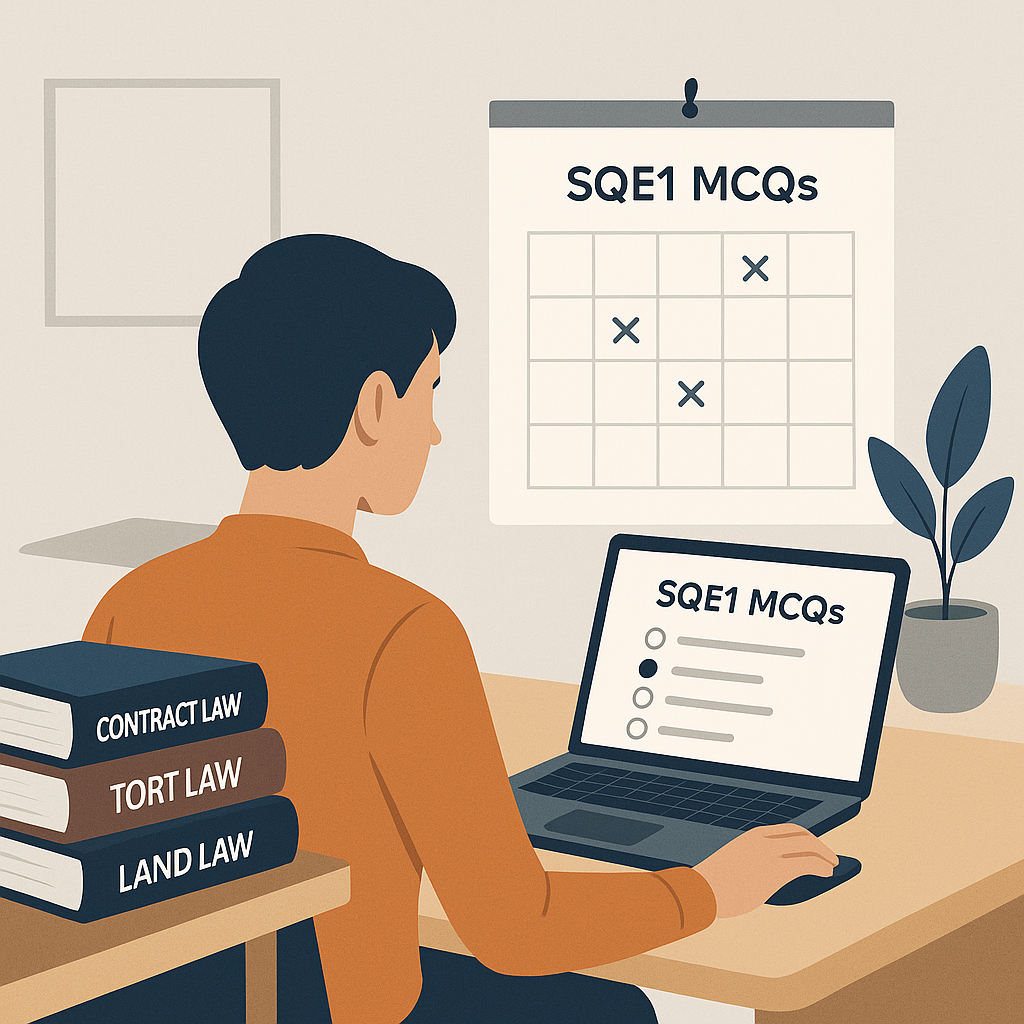
Take FLK1 topics like Tort Law or Contract Law. You might think you’ve mastered negligence or offer-and-acceptance because you reviewed them in a textbook. But put yourself in front of a single-best-answer MCQ and you’ll quickly see if you can apply those principles under pressure.
SQE1 Drills: Active Recall Made Simple
Here’s how SQE1 Drills solves the active recall problem:
- Unlimited MCQs: With over 600 questions (and 100 new ones added daily), you’ll never run out of fresh scenarios to test yourself.
- Instant Feedback Mode: Learn as you go, with explanations for correct answers, legal principles, and case law. Got an answer wrong? The AI tutor breaks down why.
- Weak Topic Detection: The real magic lies in the analytics dashboard. It flags which topics you’re scoring under 60% on, so you know exactly where to focus.
- Timed Exam Mode: Simulate the real SQE1 exam with 180-question drills. If you can pass here, you’ll feel confident on exam day.
Practical Example: Tackling Tort Law
Imagine you’re preparing for the Tort Law section. You open SQE1 Drills, run a 30-question session, and start answering MCQs on negligence. You miss three questions on duty of care. Instead of just moving on, the AI tutor explains each answer:
- Why the correct option was right: The scope of duty as established in Caparo Industries v Dickman.
- Why distractors were wrong: Misapplication of causation principles.
- Suggested prompts: “Review Bolam v Friern Hospital Management Committee. How does the Bolam test affect duty of care in professional negligence cases?”
After the session, the dashboard highlights Tort Law as a weak area. Your next drill can focus exclusively on this topic until your accuracy improves.
Building Exam Discipline
Active recall isn’t just about answering questions—it’s about consistency. SQE1 Drills includes streak tracking and weekly goal rings to keep you motivated. Answer 10 questions today? Great. Do it again tomorrow, and the next day. This daily habit builds the discipline SQE1 demands.
Final Thoughts
You might be thinking: “Can’t I just use my course provider’s question bank?” Sure, but most banks are limited in size. Once you’ve seen all the questions, your learning plateaus. SQE1 Drills keeps the material fresh, with AI-generated questions grounded in SRA specifications.
If you’re still relying on passive methods like re-reading notes, it’s time to shift gears. Active recall isn’t just a recommendation—it’s essential. And SQE1 Drills makes it ridiculously easy to integrate into your prep.
Ready to try active recall for yourself? Sign up for a free 30-day trial and see the difference.